
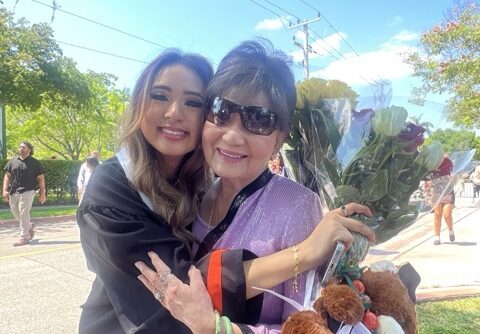
By Britney Ngo, University of Miami, Class of 2024
“Have a great day!” I said to my parents as I ended the 3 am phone call. They were in Da Nang, Vietnam, 11 hours ahead of Miami time. It was the first time in 40 years they had returned to their homeland after escaping the Vietnam War. I am a proud first-generation Vietnamese-American raised by refugees who became doctors, citizens, homeowners, and contributors to the very country that once gave them refuge.
After the fall of Saigon in 1975, my parents fled Vietnam by boat, like hundreds of thousands of others. My mother, who left in 1981, was at sea for seven days with 140 other refugees. By the second day, they had run out of food and water. On the third day, the engine broke down and fell into the ocean, leaving them adrift in the East China Sea– defenseless against the treacherous waves, pirates, and the growing fear of cannibalism.
Every evening, the refugees watched helplessly as the sun collapsed into the horizon, turning the sky to ink. Prayers ran out throughout the night, but hope dwindled with every passing hour. Finally, after a week adrift, a Japanese oil cargo ship spotted their boat and brought them to a refugee camp. My mother and her family stayed for months before resettling in Niigata, Japan. That same year, my father’s boat docked in Bidong Island in Malaysia, where over 40,000 refugees waited for a chance of freedom.
Both of my parents eventually made it to the United States. My father arrived from the island in the 1980s, and my mother arrived from Japan in 1995. Like many other immigrants, they had no money, no English language, and no knowledge of America’s legal or political system. But what they did have was a strong faith in God, their unshakeable resilience, and their belief in merit–the promise that through hard work and education, they could build a new life here in America.
My parents navigated America the only way they knew how–by climbing. My paternal grandmother worked by hand-tying balloons for events while raising five children. My father worked at a plant nursery, a gas station, and set up tents for local vendors, all while attending school. Through consistent effort and unwavering determination, my father eventually became an orthodontist. My mother immigrated to the United States when she was 19. She began with ESL (English as a Second Language) classes at the local community college, then transferred to a four-year university. She carried a tape recorder to every lecture and later translated each word at home. While in school, she worked multiple jobs simultaneously, including at a fast food restaurant and as a housekeeper, to pay for her books. My mother eventually earned her dental degree. Their path was not easy–but it was possible. That possibility is precisely why they love this country–not for its comfort, but for the privilege of opportunity.
I am a first-generation Vietnamese-American. I grew up in sunny Orange County, California, surrounded by one of the largest Vietnamese communities outside of Vietnam. In Little Saigon, anti-Communist sentiment ran deep, and so did respect for the American flag. The yellow flag of South Vietnam flew proudly in storefronts and homes, reminding us of the strength of our heritage.
In our home, politics was not about partisanship, but about principle. Our dinner table discussions often centered around freedom, sacrifice, education, and gratitude for democracy. To my family, these were not abstract concepts, but lived realities. We believe in limited government because we have seen what happens when the state becomes your master. We believe in strong family structure and faith because those were the only things they had when they arrived. We believe in the power of education, not just as a political talking point, but as a true lifeline out of poverty. My political beliefs didn’t come from the internet or from trending hashtags; they came from watching my family rise again.
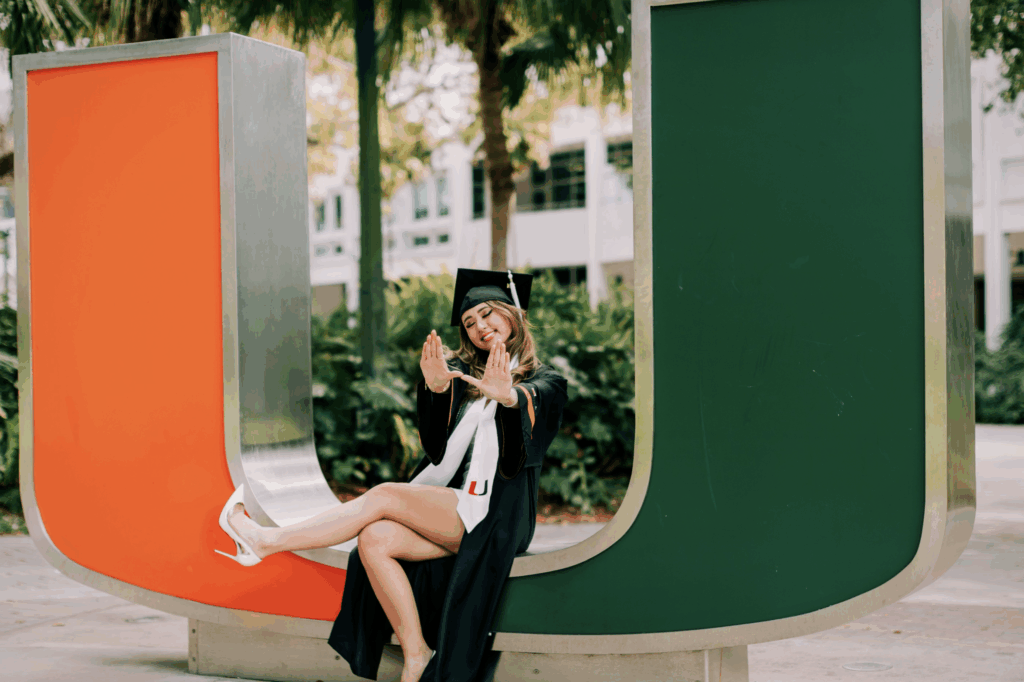
When I was 17, I packed my bags and moved to Florida to attend the beautiful University of Miami. Although I was initially nervous about moving across the country to a state where I didn’t have any friends or family, I was also incredibly eager for the opportunities it offered. Throughout college, I was on a dual pre-medical and pre-law track, majoring in Classics and minoring in Philosophy while taking medical school prerequisites. Beyond academics, Miami offered me cultural insight into the Latino community and the Latino-Asian relationship that I believe is unparalleled. In my last year of college, I took a Cuban heritage course, which, combined with my friendships here in Miami, inspired me to continue my research on the Cuban-Vietnamese relationships. Without a doubt, my time in the Miami community and my university education have profoundly shaped my identity as a first-generation Asian American.
In our current immigration environment, I believe that immigrants and refugees, especially those fleeing political oppression, deserve a chance to rebuild their lives and to earn their place in America, just like my family did. While I support border protection and legal entry, I also think the U.S. immigration process should be more streamlined. That means more funding for bilingual legal translators, immigration attorneys, and refugee resettlement programs. Education must remain the great equalizer for immigrants, for the poor, and for those without fair opportunities.
The issue of birthright citizenship has long stirred controversy within the AAPI community. Some criticize it as a “shortcut” exploited by non-citizen parents. Others argued that abandoning birthright citizenship, as proposed in President Donald J. Trump’s executive order, could render the children of non-citizen migrants stateless and restrict their civil rights. This could be problematic for the AAPI community since generations of Asian Americans are descended from immigrants.
If such an executive order were fully enacted, it could disenfranchise Asian immigrants and Asian Americans, who would then be unable to have political representation and participate in American democracy. As of November 2025, the U.S. Supreme Court has not yet ruled on the constitutionality of this Executive Order.
Asian Americans make up just 7% of the U.S. population – statistically small, but certainly not any less politically significant. I hope to see more Asian American voices in Florida, not only as voters but also as candidates and civic leaders–running for office, leading school boards, and defending the values that brought our families here. I hope we empower each other through community while speaking as individuals, with distinct stories and perspectives.
We are not a monolith. But we are American. And we are here to stay.